
By María José Gamba
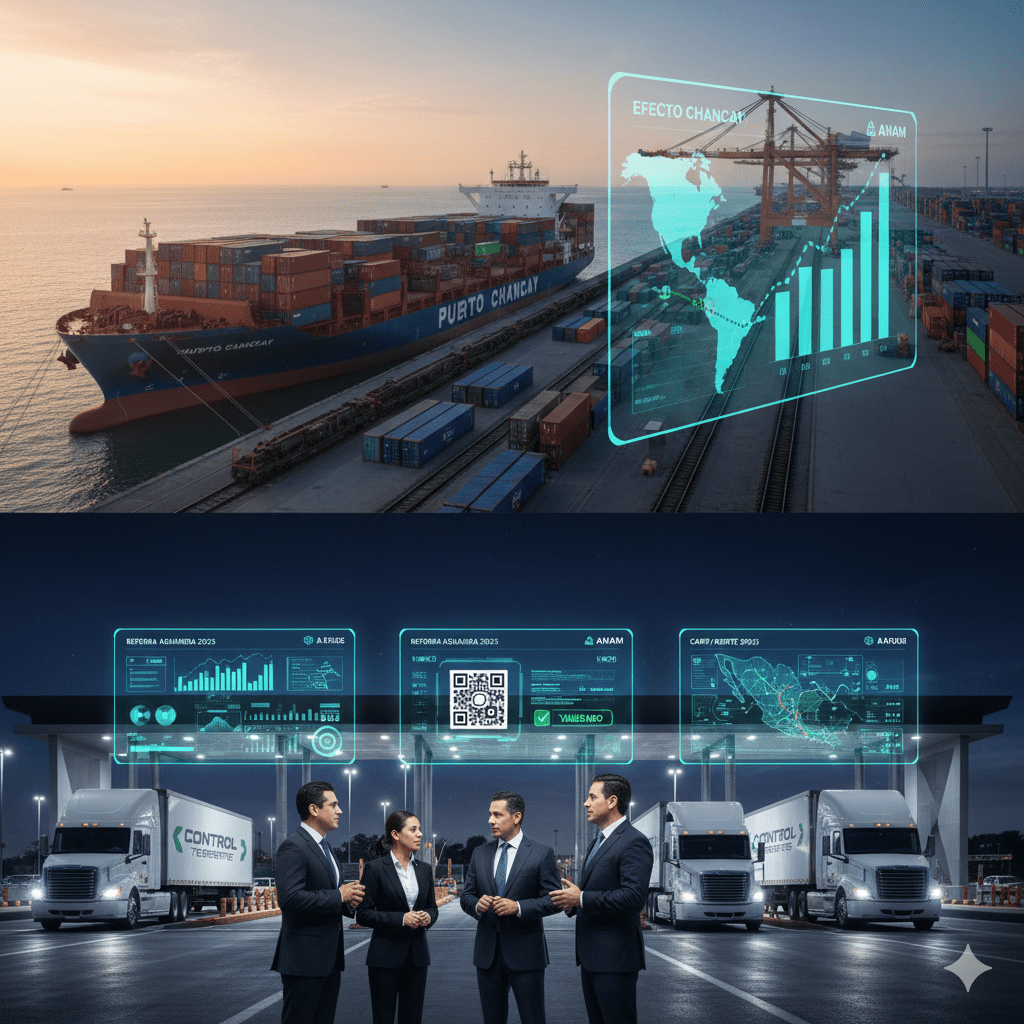
The end of 2025 marks a total reconfiguration of international trade in the Western Hemisphere. Two major factors are forcing exporters and importers to redesign their supply chains: the full operational launch of the Chancay Megaport in Peru and the enactment of Mexico’s 2025 Customs Law Reform. While the first threatens to reroute cargo that traditionally flowed through Mexican and US West Coast ports, the second imposes unprecedented digital oversight on the US-Mexico border. At Americas Freight, we analyze how these shifts redefine the logistical landscape and how we prepare our clients for this new environment.
The Chancay Impact: A New Rival for the Pacific Corridor
The Chancay Port has begun receiving “megaships” that previously could only dock in North American ports. This shift creates an immediate change in Pacific trade routes:
Direct Asia-South America Routes: Chancay reduces transit times to South America by up to 10 days. Consequently, Mexico is no longer the mandatory stop for regional redistribution.
Pressure on the US-Mexico Corridor: Ports like Manzanillo (MX) and Long Beach (USA) now face urgent pressure to modernize. They must compete with the efficiency of this new Peruvian giant.
The Demand for Land Freight: Paradoxically, the success of Chancay increases the demand for high-efficiency trucking in Mexico. This is because manufacturing hubs within the USMCA (T-MEC) region still rely on a fast, integrated land network to reach the US market.
As a result, logistics is no longer just about moving goods. It is about speed and strategic positioning within a changing map.
The 2025 Customs Reform: Zero Tolerance for Digital Errors
The customs reform that took effect in late 2025 has fundamentally changed liability rules. Specifically, fiscal oversight is now 100% digital and preventive.
Strict Carrier Liability: The new rules demand perfect documentary traceability. Any error in the digital “Carta Porte” (Waybill) can halt operations indefinitely at the border.
AI-Driven Customs: Mexico’s National Customs Agency (ANAM) now uses real-time risk analysis. This speeds up crossings for compliant companies but severely penalizes those with manual or outdated processes.
Faster Inventory Turnover: Customs storage periods have shortened. This forces companies to maintain a much faster inventory rotation and precise coordination with their freight forwarders.
Therefore, operating in 2026 requires more than just trucks. It requires a robust technological infrastructure that connects directly with customs systems.
Americas Freight: Leading Through Complexity
At Americas Freight, we have anticipated these changes by investing in three strategic pillars to ensure your business continuity:
Digital Compliance Shield: Our systems integrate the latest 2025 Waybill (Carta Porte) updates. We guarantee that every shipment meets the strict requirements of the new reform.
Strategic Route Intelligence: Faced with the Pacific’s reconfiguration, we offer optimized intermodal and land routes. We connect South and Central American hubs with the US border without bottlenecks.
Next-Gen RTLS Monitoring: We provide total visibility and cargo traceability. This is now a mandatory requirement to meet the fiscal standards of both ANAM in Mexico and CBP in the United States.
In conclusion, the “Chancay Effect” and the 2025 Customs Reform are more than just challenges; they are a filter. Only competitive and digitally-ready companies will thrive. Success in 2026 depends on your ability to adapt to a digital, fast, and transparent logistics model.
Is your company ready for the new rules of global trade? At Americas Freight, we have the technology and expertise to guide you. Contact us today and secure your competitive edge in the North American market.